


Key Takeaways:
- A well-planned compressor room is essential for maximizing operational efficiency, accommodating current needs, and ensuring future scalability by carefully integrating airflow and accessibility.
- Choosing the optimal location, whether centralized for monitoring or decentralized for efficiency, significantly impacts system performance, maintenance, and overall control.
- Critical design elements include planning for future expansion, safeguarding ambient air quality, and effective ventilation to guarantee long-term flexibility and maintain system stability.
Designing a compressor room is necessary when air demand rises or operational priorities evolve. If you experience space constraints or need to meet stringent industry requirements, strategically using compressed air in your facility can improve operational efficiency.
You’ll need to incorporate various compressor room design factors, including airflow management and equipment accessibility, to accommodate your current needs and scale as you expand.
1. Determining the Compressor Room Location
The first design consideration for your compressor room is location. Where you position your compressor room influences system efficiency and scalability.
System Placement
A centralized compressor room is the operational core of the compressed air system. Grouping compressors in one location simplifies monitoring and maintains consistent airflow control. Centralization also enables technicians to monitor system performance and complete predictive maintenance.
As facilities expand, decentralized placement may enhance distribution efficiency. Positioning compressors closer to high-consumption areas shortens air delivery paths and stabilizes pressure at the point of use.
Proximity to Equipment
Compressed air systems operate interconnectedly. Locating compressors near supporting infrastructure, such as dryers and drains, reduces piping length and minimizes pressure losses. This proximity also improves maintenance workflow, allowing technicians to move efficiently between compressors and treatment equipment when servicing them.
Ambient Air Quality
The surrounding environment directly affects the quality of air entering the compressor, which in turn influences downstream performance and maintenance demands. Airborne particles and industrial vapors increase filtration load and accelerate component wear, making ambient conditions a critical factor during site selection. Choosing a location with cleaner intake air reduces strain on filtration and drying systems and maintains a more stable, reliable air supply.
System Expansion
Designing your compressor room with future capacity in mind allows the system to expand efficiently.
Allocating additional space for future compressors, planning piping infrastructure with expansion capacity and ensuring electrical supply can handle higher loads all contribute to long-term flexibility.
2. Controlling Air Compressor Room Ventilation
Compression converts electrical energy into heat, which influences system stability. Compressors in facilities that implement environmental control strategies operate within their intended temperature range. Consider the following compressor room ventilation design factors.
Heat Rejection Loads
Compressors release a measurable quantity of heat into the surrounding space. By understanding heat rejection load, you can determine how much airflow the room requires to maintain stable operating temperatures.
Heat output depends on compressor size, operating cycle and total system load, which makes accurate calculation essential for ventilation planning. Consider partnering with an air expert who can evaluate your compressor specifications and room dimensions to appropriately size the ventilation ducting.
Inlet and Exhaust Ducting
Effective ventilation draws cooler air into the compressor intake zone and directs warm air away from the equipment, creating a controlled circulation path. Properly positioning the inlet and exhaust ducting maintains a stable room temperature.
Thermostatically controlled dampers enhance this system by adjusting airflow automatically in response to temperature changes. This responsive control maintains optimal thermal balance while improving energy efficiency, since airflow increases only when operations require it.
Heat Recovery Opportunities
A significant portion of the electrical energy used during compression converts into heat. Rather than releasing this heat entirely into the atmosphere, facilities can redirect it for productive use.
Heat recovery systems capture warm discharge air and route it into adjacent spaces, where it can supplement heating during colder months. This approach transforms thermal by-product into useful energy, improving overall system efficiency.
3. Maximizing Layout and Physical Space
A well-planned layout ensures uninterrupted operational flow and safe access to equipment.
- Minimum clearance: Compressor rooms with unimpeded access improve airflow and allow techs to easily access serviceable components. The Occupational Safety and Health Administration requires that facilities provide and maintain sufficient space around electrical equipment so qualified personnel can operate it safely. It also specifies a minimum clearance of at least 3 feet around exposed energized parts.
- Floor load capacity: Compressors exert concentrated loads and generate vibration during operation. A reinforced foundation or vibration-isolating base helps distribute equipment weight evenly while minimizing transmitted vibration. Confirming flood load capacity during planning ensures the building structure supports static weight and operational forces.
- Doorway widths: Planning adequate doorway width and unobstructed entry paths simplifies equipment placement and may reduce installation time. This foresight also enables system expansion, allowing new equipment to integrate into the existing layout.
- Lighting: Bright, evenly distributed illumination enables technicians to accurately do their work. Consider energy-efficient lighting solutions to improve visibility while reducing energy consumption and heat generation in the compressor room.
4. Factoring Safety and Compliance
Another design consideration for your compressor room is how well it protects people and equipment. When electrical design, condensate handling, noise management, fire protection and emergency controls work in tandem, the space can operate smoothly.
Electrical Supply Placement
Reliable electrical infrastructure supports stable compressor performance and safe maintenance access. Compressors require a correctly sized power supply, proper grounding and protection against voltage fluctuations.
Clearly labeled disconnect switches should remain easily accessible so technicians can isolate power quickly during servicing. This placement promotes proper lockout and tagout practices for safe maintenance conditions.
Condensate Disposal
Compressed air naturally produces condensate composed of water, oil and trace contaminants. Effective management protects system performance and environmental responsibility. Engineered condensate management solutions separate oil from water, allowing treated discharge while capturing residual oil for proper handling. These systems simplify compliance with environmental standards.
Fire Safety
Compressed air systems involve electrical equipment and thermal energy, which influence fire risk considerations. Integrating fire-rated construction materials, maintaining access to suppression systems and ensuring sprinkler coverage aligns with building safety standards supports controlled risk management.
Fire safety planning is most effective when integrated early in air compressor system design, since equipment placement and airflow paths influence suppression effectiveness.
5. Choosing an Air Compressor
The type of air compressor you choose determines how efficiently your system operates and how well it enables long-term goals. Below are some options to consider.
Rotary Screw Compressors
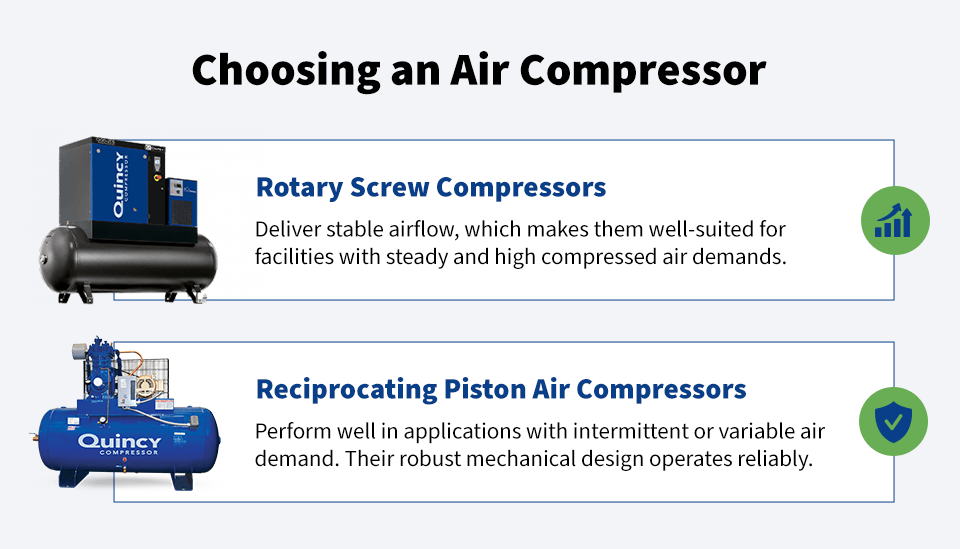
Rotary screw compressors deliver stable airflow, which makes them well-suited for facilities with steady and high compressed air demands. Their design provides for extended duty cycles, consistent pressure output and quiet operation. Because they operate smoothly under sustained load, rotary screw compressors are often the primary air source in various industries.
Reciprocating Piston Air Compressors
Reciprocating piston air compressors perform well in applications with intermittent or variable air demand. Their robust mechanical design operates reliably. They may serve as supplemental or standby compressors alongside rotary screw systems, which provide flexibility during peak demand or maintenance intervals. This adaptability allows facilities to balance energy use with operational needs.
6. Incorporating Auxiliary Equipment
Compressed air quality depends on the equipment that manages air as it moves through your system. Here are some auxiliary components that maintain consistent air quality.
- Dryers: Moisture naturally forms during compression, and controlled drying protects end-use equipment from corrosion and contamination. Selecting the appropriate dryer based on your pressure dew point requirement supports consistent air quality.
- Filters: Filtration removes particulates and airborne contaminants introduced during compression. Multistage filtration improves air quality and protects equipment and products. Clean air also stabilizes downstream components for consistent energy performance across the system.
- Drains: Condensate accumulates naturally in components within the system. Drains remove buildup, maintaining airflow stability. Consistent condensate removal allows for steady system pressure and improves operational efficiency.
- Purifiers: Condensate typically contains oil and water mixtures that require proper separation before disposal. Condensate purification systems separate these elements, which allows treated water discharge while capturing oil for appropriate handling.
Partner With Quincy Compressor to Design a Reliable Compressor Room
Designing a compressor room is a long-term operational investment, and the right partner can help you sustain lasting value. Quincy Compressor has over 100 years of experience building reliable compressed air systems for a wide range of industries.
Our portfolio includes rotary screw compressors, reciprocating piston air compressors and air treatment solutions that support your facility’s performance.
Through our authorized partners, we provide responsive 24-hour service. We reinforce reliability through industry-leading warranty protection plans, including extended coverage for rotary screw and reciprocating compressors.
Find a dealer today to get started.