


Manufacturing, pharmaceuticals, food processing, aerospace, automotive and healthcare are some of the industries that commonly use vacuum pumps to improve process control, product quality, safety and efficiency.
Vacuum pumps are mechanical devices that remove air and other gases from a sealed space to create a partial vacuum. This technology is essential for processes that demand clean, controlled or contaminant-free environments. Whether it’s ensuring the purity of pharmaceuticals, the safety of packaged food or the functionality of high-tech manufacturing lines, vacuum pumps help businesses meet industry regulations and drive consistent results.
Because each application has different vacuum requirements, businesses often choose pumps based on flow rate, vacuum level, duty cycle and process conditions. Matching the pump to the application helps teams protect product quality, limit downtime and maintain consistent performance across demanding production, testing and care environments.
1. Manufacturing
Manufacturers use vacuum pumps for packaging, metal processing, CNC routing and material handling. These pumps help secure components, remove air and contaminants and keep production lines running smoothly to improve efficiency and reduce defects.
2. Pharmaceuticals
In the pharmaceutical industry, vacuum pumps support controlled processes and help with freeze-drying, filtration, distillation and packaging. This leads to cleaner products, consistent quality and compliance with strict manufacturing standards.
3. Food and Beverage Processing
Food processors rely on vacuum pumps to preserve freshness and extend shelf life by removing air from packaging. These pumps also support processes like freeze-drying and safe bottling, while helping reduce spoilage, microbial growth and recall risks.
4. Aerospace and Automotive
The aerospace industry and automotive companies use vacuum pumps for critical operations such as composite molding, brake system testing, fuel system processing and wind tunnel simulations. These pumps help maintain precise testing conditions, support quality assurance and improve the safety and performance of vehicles and aircraft.
5. Healthcare and Medical Facilities
Healthcare and medical facilities depend on vacuum pumps for surgical suction, sterilization, wound drainage and laboratory applications. These pumps support infection control, patient care and reliable operation for essential medical procedures and diagnostics.
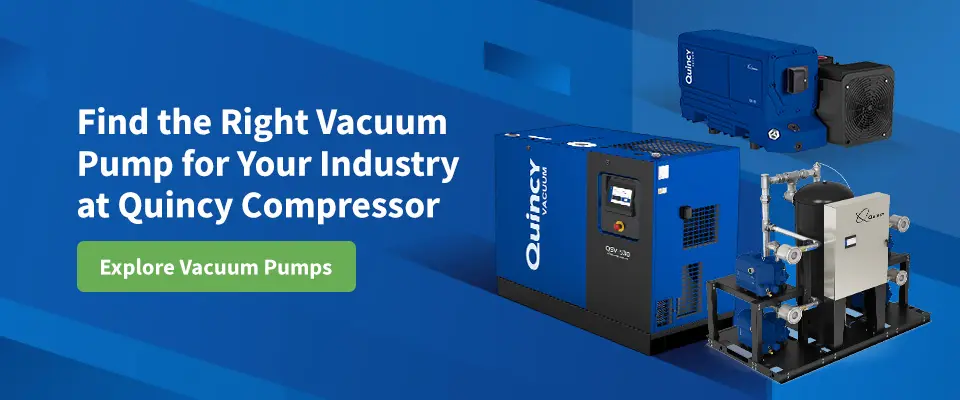
Find the Right Vacuum Pump for Your Industry
The right vacuum pump for your business depends on your industry, application, vacuum level and operating environment. Quincy Compressor offers vacuum pump solutions for manufacturing, food and beverage processing, healthcare, automotive, aerospace and other demanding industries. Explore our full range of vacuum pumps or contact Quincy Compressor to find equipment that fits your process and keeps your operations running reliably.