


Some industrial processes require dew points below 35°F to 40°F, a range that refrigerated dryers cannot reach. Heatless, heated and blower purge dryers close that gap by adsorbing moisture from compressed air. Each can produce reliably dry results. The method each type uses to regenerate desiccant makes them unique, and that difference drives real swings in power use, operating costs and application fit.
A Quick Side-by-Side Comparison
The table below breaks down the key differences between a heatless, heated and blower purge dryer to give you a quick comparison of which type fits your operation.
| Dryer Type | Purge-Air Loss | Sources of Energy Consumption | Dew Point | Suitable Applications |
|---|---|---|---|---|
| Heatless | 10% to 18% | Main air compressor load | -40°F to -100°F | Low flow or intermittent use, remote worksites, hazardous locations |
| Heated Purge | 1% to 7% | Electric heater and compressed air | -40°F to -100°F | Midsized continuous or batch operations |
| Blower Purge | Virtually none | External heater, blower motor, compressed air | -40°F to -100°F | Large-scale, 24/7 high-demand operations |
What Is a Heatless Desiccant Air Dryer?
A heatless desiccant air dryer removes moisture from compressed air using two parallel towers filled with a moisture-absorbing desiccant. One tower dries the airstream while the other regenerates through pressure swing adsorption, where a portion of already-dried air flows backward through the offline tower at low pressure to strip away moisture. No auxiliary heat enters the process.
Benefits of Heatless Desiccant Dryers
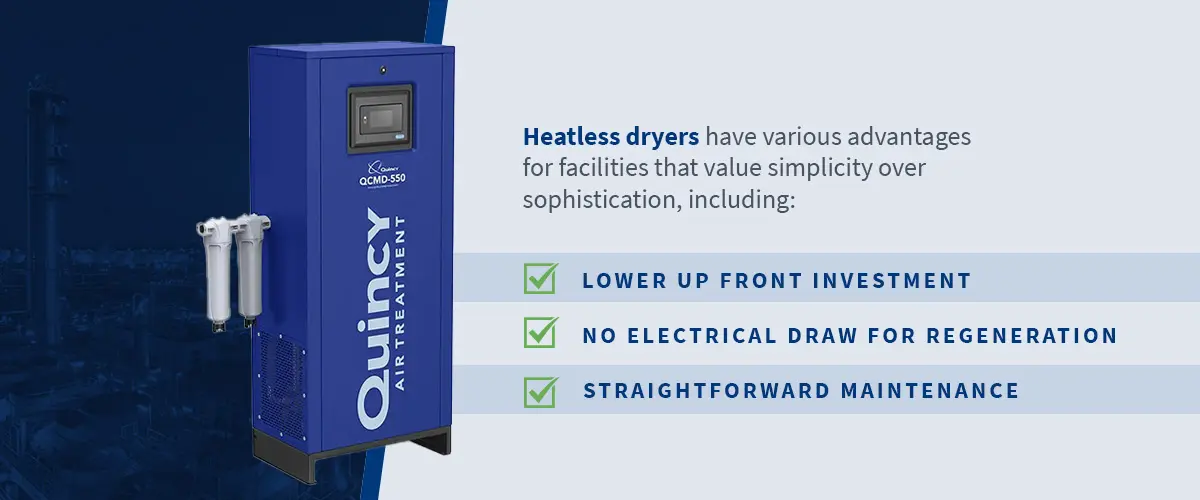
Heatless dryers have various advantages for facilities that value simplicity over sophistication, including:
- Lower up front investment: The mechanical design helps keep capital costs below those of other desiccant dryer types.
- No electrical draw for regeneration: Pressure swing adsorption works without a heater or blower. The only energy consumption to account for is the main air compressor load.
- Straightforward maintenance: Few moving parts likely mean fewer failure points to track during ongoing inspections and maintenance.
A heatless dryer makes sense for facilities with intermittent or low-flow use. The absence of electrical heating elements also makes this design a more suitable option for off-grid or explosion-rated environments.
Trade-Offs to Consider
Purge air consumption runs 10%-18%, and the system generally purges at full rate whether the air is saturated or barely humid. Pressure drops may also occur. In many facilities, this fixed consumption turns the heatless dryer into the single largest draw on the compressed air system.
What Is a Heated-Purge Desiccant Air Dryer?
A heated desiccant air dryer uses the same twin-tower structure as a heatless design, but routes the regeneration air through an electric heater before it enters the offline tower. This differs from heated blower purge dryers, which pair a blower with a heater and regenerate using ambient air.
Benefits of Heated-Purge Desiccant Dryers
Many facilities choose heated-purge dryers for these advantages:
- Minimal purge air consumption: Heated air holds more moisture than ambient-temperature purge air, so these systems generally require less airflow to regenerate the desiccant bed. This reduces purge consumption to just 1%-7% of the total compressed air.
- Enhanced efficiency: Heated-purge dryers often cost less to operate because the savings from reduced air purge tend to outweigh the increase in energy use.
- Versatile applications: Heated purge dryers are suitable for most midsized operations with continuous or batch-based flow requirements.
Facilities running continuous shifts with moderate-to-large compressed-air demand often find this middle-ground design worth the investment.
Trade-Offs to Consider
Heated-purge dryers carry a higher up front cost than heatless models, reflecting the added heater and control components. The heating element requires continuous energy use during regeneration, and its electrical demand scales significantly with large-capacity models. The addition of the heated component also gives maintenance teams another component to inspect.
What Is a Blower Purge Desiccant Air Dryer?
A blower purge desiccant air dryer regenerates its offline tower with air supplied by external blowers, leaving the facility’s compressed air supply untouched. These blowers draw in ambient air, pass it through a heater and direct the heated airflow through the offline tower to strip moisture. Compressed air flow occurs only during a brief cooling phase, not as a continuous draw throughout the cycle.
Benefits of Blower Purge Desiccant Dryers
Benefits of blower purge dryers include:
- Virtually no air purge: Blower purge dryers eliminate compressed-air purge, with nearly all system output going straight to end-use equipment.
- Reliable and consistent performance: Heated purge systems often cause pressure fluctuations when purge valves open and close or when compressed air is diverted backward through the system. Blower purge systems isolate the regeneration loop from the main air stream, maintaining more consistent line pressure. Automated controls continuously manage the regeneration cycle, adding a layer of reliability and easing day-to-day operations for maintenance teams.
- Long-term efficiency: Over the equipment’s service life, the efficiency gained from eliminating purge air loss may help offset the higher initial investment.
A blower purge dryer suits high-volume continuous-duty operations where strict air quality requirements leave little room for purge losses or downtime. Industries such as food and beverage processing or pharmaceutical manufacturing often fall into this category, given their sensitivity to moisture and particulates.
Trade-Offs to Consider
Blower purge dryers carry the highest up front capital cost of the three designs due to the added blower and heater components. These systems typically have the largest power draw, as energy is required to power the external heater and blower motor on top of the air compressor. Additional parts also translate to more extensive maintenance requirements.
Frequently Asked Questions About Desiccant Air Dryers
A few more questions come up when facilities compare desiccant dryer options.
1. What is the difference between a heatless and a heated-purge desiccant dryer?
The difference comes down to the regeneration method. A heatless dryer regenerates using unheated compressed air and is often the most suitable choice for hazardous or remote operations. A heated-purge dryer adds a heater, significantly reducing purge loss.
2. How often does the desiccant need to be replaced?
Replacement schedules vary by dryer type, but most desiccant beds require replacement every 3 to 5 years. Oil contamination shortens that lifespan, making filtration essential for protecting the desiccant drying media inside the dryer.
3. Can desiccant dryers be used with oil-injected compressors?
Yes, but only if paired with adequate upstream coalescing filtration that protects the desiccant bed from oil contamination.
4. What is the lowest pressure dew point (PDP) a desiccant dryer can achieve?
Desiccant dryers are typically rated for a -40°F dew point but can go as low as -100°F.
5. How do I know the pressure dew point I need for my application?
Desiccant air dryers are necessary for dew points below 35°F. Facilities should consult ISO 8573-1 and determine which class best aligns with their operations.
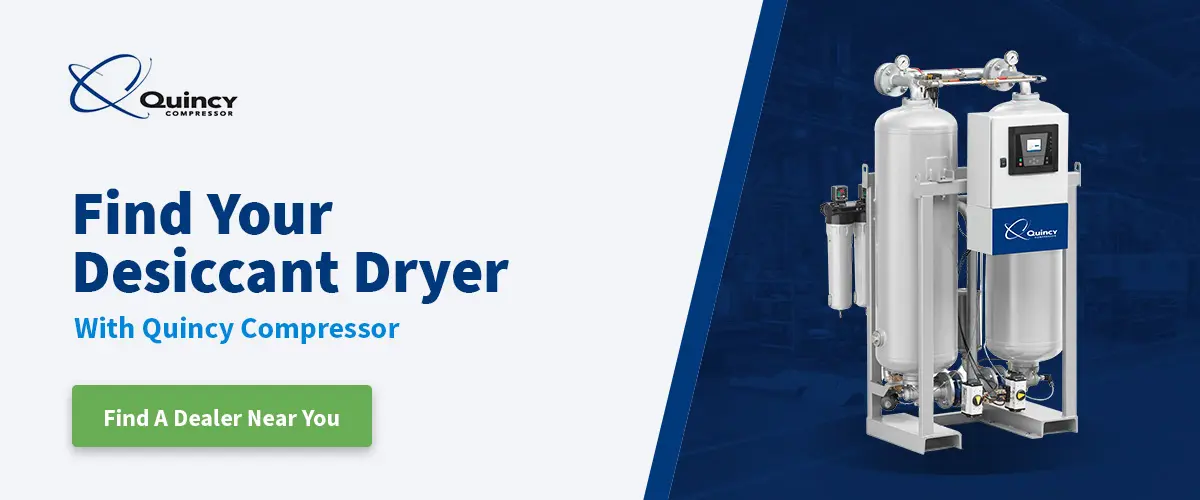
Find Your Desiccant Dryer With Quincy Compressor
Quincy Compressor manufactures heatless, heated-purge and blower purge desiccant dryers to meet nearly any application requirement. Quincy has remained trusted in the industry for nearly a century, backed by consistent performance across demanding environments. An authorized dealer representative can match the right model to your flow, pressure and environment needs.
Find a local dealer and get a recommendation built around your application.