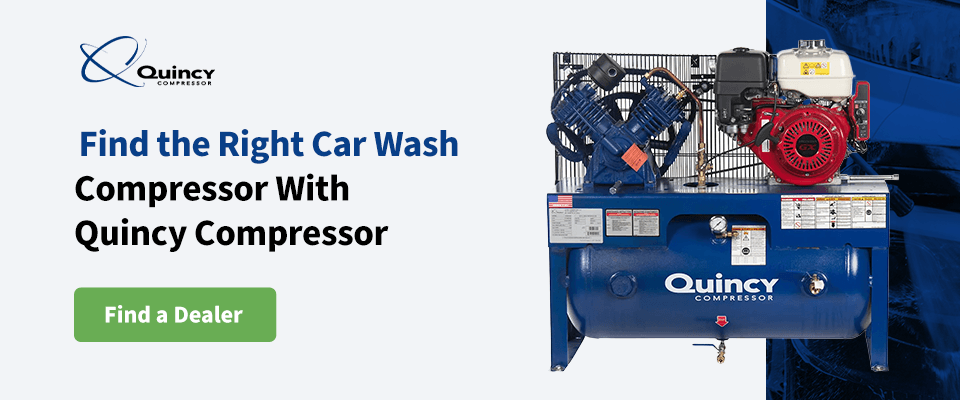



Today’s car wash operations depend on having a reliable compressed air system, powering everything from conveyors to drying nozzles. Too often, facilities face inconsistent performance and costly breakdowns due to inadequate air compressors.
Quincy Compressor understands these challenges. We provide industrial-grade air compressor solutions engineered to ensure continuous, efficient service, protecting your investment against downtime and maximizing throughput for every wash.
Rotary Screw vs. Piston Air Compressors for Car Washes
The right car wash compressor depends on how the wash actually runs. The same logic applies when choosing an air compressor for car detailing, which relies on similar pneumatic tools.
- Rotary screw compressors suit high-volume and tunnel operations that need a steady, uninterrupted air supply, since they’re built to run continuously without overheating.
- Piston compressors are built for intermittent demand and need periodic rest between cycles, which makes them a better fit for self-serve bays where usage comes in bursts rather than a continuous draw.
While piston compressors cycle between cut-in and cut-out pressure settings, rotary screw units hold a steadier discharge level. Quincy offers a compressor built for each side of this equation:
- The Quincy QGS rotary screw compressor is designed to support demanding compressed-air applications, with available configurations and warranty coverage that may vary by model.
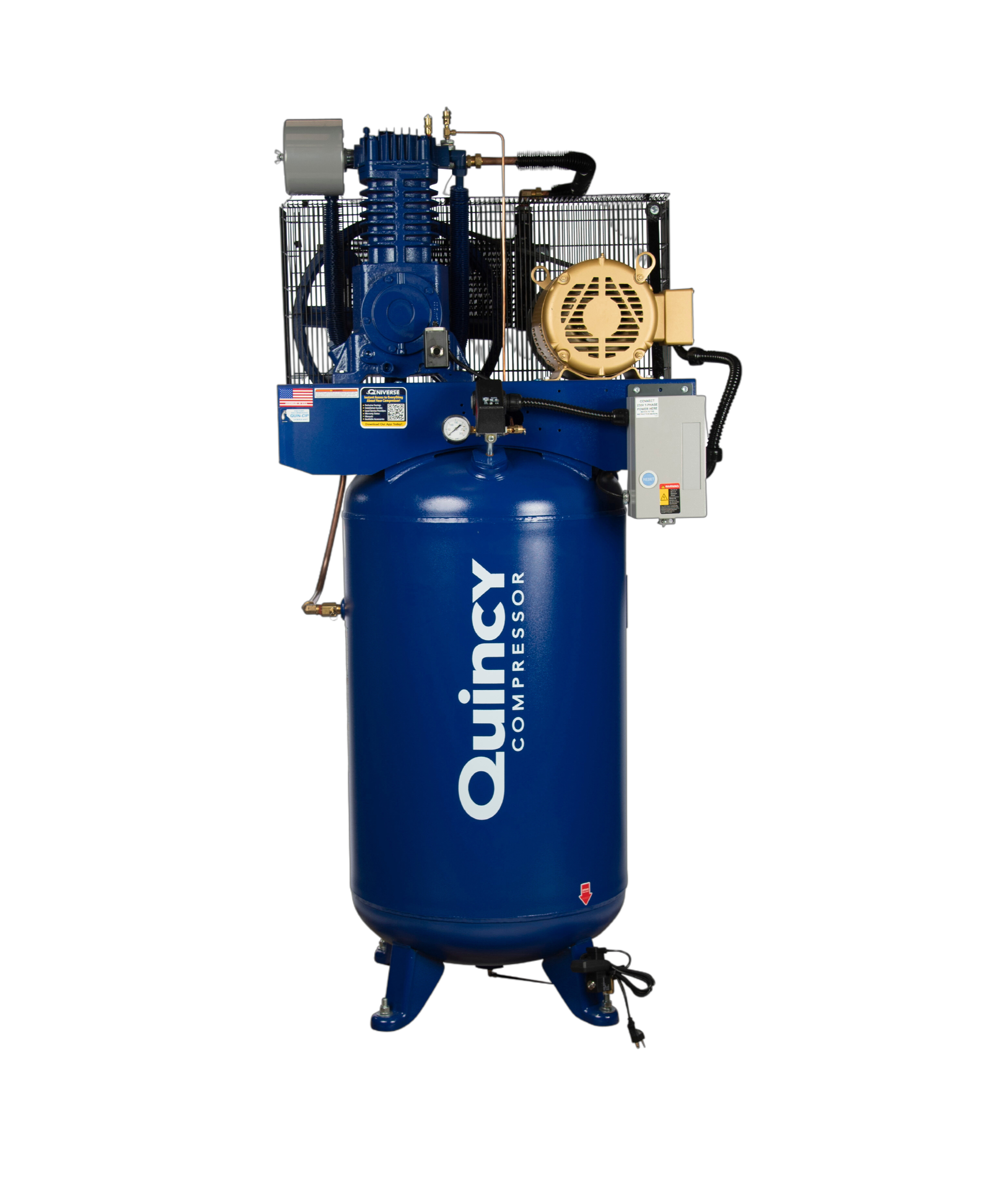
- The Quincy QT two-stage piston compressor is built for intermittent-duty applications where operators need dependable compressed air in a piston compressor format.

How to Select the Right Air Compressor for Your Car Wash
Selecting a compressor for vehicle washing requires more than matching horsepower to a wash type. Operators should weigh several interdependent factors to ensure their compressors keep pace through every shift.
CFM Requirements and Duty Cycle
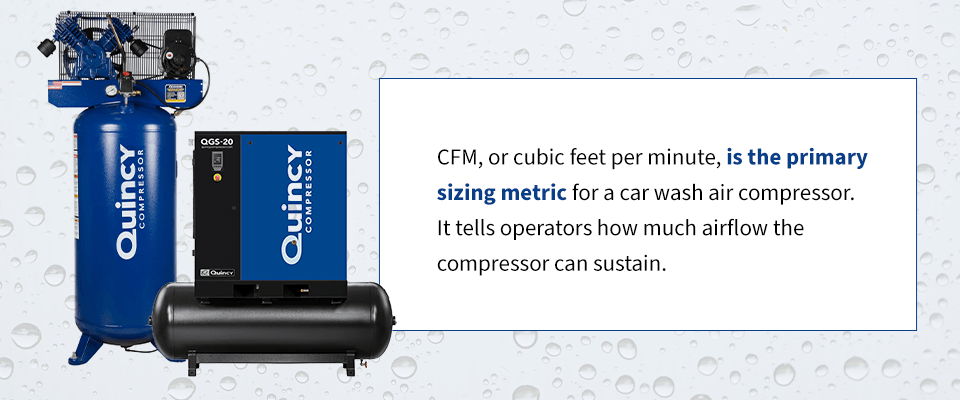
CFM, or cubic feet per minute, is the primary sizing metric for a car wash air compressor, whether the goal is to run a full tunnel or simply to choose an air compressor for washing a car in a single self-serve bay. It tells operators how much airflow the compressor can sustain, which is determined by the total load of all devices running at once.
Sizing starts with totaling the CFM requirements of every pneumatic device in the system, including actuators, chemical pumps, blow-off nozzles and vacuum islands. Before choosing a compressor, document which components run at the same time, how long each demand period lasts and whether planned equipment upgrades could increase air use. This demand profile gives operators a more accurate starting point than horsepower alone
From there, account for system leaks, peak demand and future equipment additions, since undersizing CFM can contribute to pressure drops during busy operating periods. Blow-off nozzles and chemical pumps are typically the largest continuous air consumers in a tunnel wash, so size these first.
Duty cycle follows naturally from this math. An express tunnel running near-continuously needs a compressor rated for 100% duty, while a self-serve bay can work with a lower duty-cycle piston unit. Pushing a compressor beyond its rated duty cycle for extended periods can increase wear and raise the risk of premature failure.
PSI and Tank Size
PSI is the pressure an air compressor for car wash use can produce. Most pneumatic tools in a car wash need a comparable range to operate properly, so confirming the compressor’s output matches end-use requirements is essential.
Tank, or receiver, size matters just as much, since a properly sized receiver absorbs the spiky cycling load created by a tunnel full of solenoids and prevents short-cycling. Larger washes with more simultaneous demand need bigger tanks, and inconsistent pressure at the point of use is often a sizing issue there rather than with the compressor itself.
The Quincy QT delivers up to 175 PSI, while the Quincy QGS operates at 125-150 PSI.
Air Treatment and Moisture Control
Compressed air naturally carries moisture, which can cause valves to stick or freeze in cold climates and accelerate seal wear over time. Those failures can lead to technician visits, parts costs and downtime that keep the wash from generating revenue.
A refrigerated air dryer is the baseline solution for most car washes because it helps reduce moisture before it reaches valves, nozzles and other pneumatic components. In climates where air lines run through unheated spaces, a desiccant unit may be needed on those legs, since refrigeration alone will not reliably prevent freeze-up. Proper air compressor filters downstream of the compressor also help protect components from contaminants that can increase maintenance costs.
Energy Efficiency and Total Cost of Ownership
The compressor that costs less up front often proves more expensive over time if it uses more electricity, cycles inefficiently or needs frequent repairs. For car washes that run most of the day, a rotary screw compressor may offer a lower total cost of ownership because it can deliver steadier airflow under continuous demand. Operators should compare purchase price, expected run time, maintenance needs and energy use before choosing a system.
Frequently Asked Questions About Car Wash Air Compressors
Learn more about air compressors for your car wash with these answers to FAQs from Quincy:
Sizing starts with wash type, though the precise size depends on the full equipment list. Self-serve bays typically do well with a two-stage piston compressor in the 5 to 15 HP range, while in-bay automatics often need a small rotary screw or heavy two-stage piston.
Rotary screw compressors make the most sense for near-continuous demand, including express tunnels and busy in-bay automatics, while two-stage piston compressors suit genuinely intermittent demand, such as self-serve bays. What matters most is the operation’s duty cycle, not the wash type alone. See the comparison above for more details.
An authorized Quincy Compressor dealer is the place to start. Our dealers assess a car wash’s specific air demand, environment and layout before providing installation support and 24-hour service.
Why You Can Rely on Quincy Compressor
Choosing between rotary screw and piston technology comes down to matching the equipment to daily demand. Sizing for CFM, PSI, tank capacity and moisture control determines whether that choice pays off in steady pressure and fewer breakdowns.
Quincy Compressor brings professional performance and reliability to demanding car wash environments, where consistent pressure, moisture control and dependable uptime are essential to keeping vehicles moving. We offer purpose-matched solutions for self-serve bays, in-bay automatics and express tunnels. An authorized dealer can assess a car wash’s air demand and layout, backed by a network of professional and knowledgeable air experts.
Through authorized partners, Quincy also provides access to 24-hour service support, helping car wash operators address compressor issues quickly and reduce the risk of extended downtime.
Find the Right Car Wash Compressor With Quincy Compressor
Quincy Compressor provides high-quality, high-performing air compressors for your car wash. Find a Quincy dealer in your area to get started.