



[Summary: Installing an air compressor in your garage makes a wide range of projects faster, easier and more precise.
- Versatility: A single compressor can power many tools.
- Efficiency: Pneumatic tools complete tasks in a fraction of the time compared to manual equivalents.
- Performance: Compressed air delivers consistent, reliable power for both light-duty and more demanding applications.
- Value: A properly sized and installed air compressor is a long-term investment that expands what you can accomplish in your workspace.
To set up an air compressor in your garage or workshop successfully, secure the unit in a well-ventilated location on a stable surface, connect it to a dedicated power source, and distribute air through the workspace using proper hoses and fittings.]
For people who use a variety of power tools, air compressors make operations much easier. In contrast to the sweat and strain that often goes into the manual use of wrenches, saws and hammers, an air compressor combined with pneumatic equivalents can make such applications feel relatively effortless. As such, air compressors have grown in popularity for all types of power-tool applications.
Just as factories and manufacturing plants continue to build more elaborate compressed-air systems, the technology is also being adopted for home use by independent craftspeople, making a wide variety of projects much easier.
While it’s relatively easy to install an air compressor in a residential garage, some basic things should be understood about machine capacity and your air tool requirements.
Contact Us Learn More Find a Dealer Near You
The Five Crucial Specifications of an Air Compressor
Air compressors vary in terms of capacity because different machines are built for different levels of operation. When it comes to air compressor installation in your home garage, there are five main things to consider in the model you choose:
Cubic feet per minute (cfm)
The most important quality of an air compressor is its cfm rating, which determines how much air is produced by the compressor. All pneumatic tools demand certain levels of cfm, and an air compressor must be able to meet all the demands for the tools in your arsenal.
For example, with a compressor rated 9.0 cfm, enough air will be generated each minute to power a wrench that demands 5.0 cfm. However, a tool that demands twice as much cfm will need a higher capacity compressor of 14 cfm or more.
Pounds per square inch (psi)
The pressure at which air is delivered from a compressor — measured in terms of psi — is another critical factor in the ability of an air compressor to power pneumatic tools properly. Certain tools demand higher psi than others, and an air compressor must exceed the maximum rating from a given set of tools to cover the owner’s working needs.
The majority of popular garage tools demand 90 psi. However, psi ratings must be read in conjunction with cfm ratings, which are a larger indicator of whether a compressor can handle the demands of a particular tool. As a rule of thumb: the greater the cfm and psi rating of a machine, the broader the range of tools that can ultimately be powered.
Horsepower
This is the measure of an air compressor’s motor output. Though significant, the cfm and psi ratings of a unit are better indicators in the overall power. As the two ratings increase, so too does the horsepower.
Tank volume
The amount of compressed air a specific model can hold at a given time is also important. The greater the holding capacity, the easier it is on the motor during each usage cycle — especially during projects that alternate between active and idle modes. Tank volume indicates the holding capacity of the air compressor.
Duty cycle
Another crucial factor is the length of time an air compressor can run before shutting down to cool. Generally speaking, a compressor should have a duty cycle of 50% or more to operate tools that involve prolonged applications, such as saws and grinders. Additionally, a compressor needs a sizable motor and tank to run cycles of sufficient length for those applications. It’s also important to consider your garage’s power rating. Be careful to select a compressor that can be operated at the correct voltage. Always consult with a licensed electrician to ensure proper selection and installation requirements.

How to Install an Air Compressor in Your Garage or Workshop
Once you’ve selected and purchased an air compressor of sufficient capacity, it’s time to complete your garage air compressor setup. The compressor installation process can be broken down into six steps:
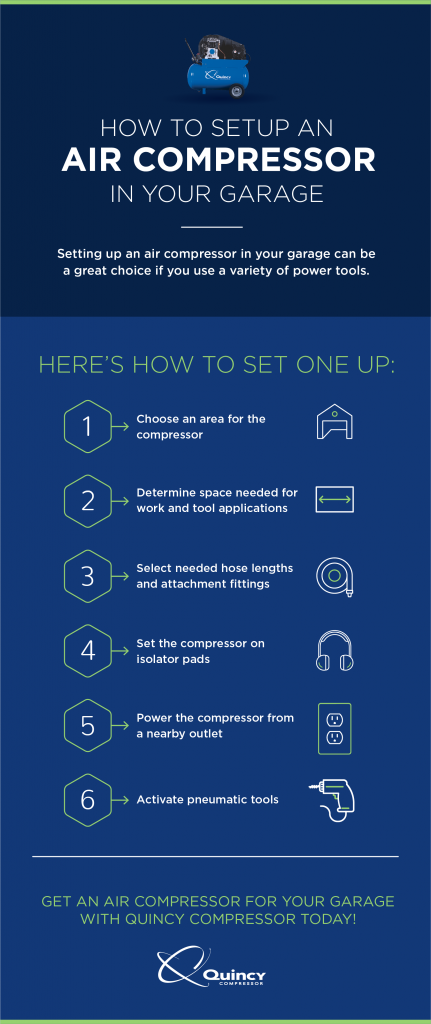
Step 1: Choose the Right Location
Where you place your compressor directly affects its performance, lifespan and noise level.
- Ventilation and airflow: Position the compressor in a well-ventilated, dust-free environment. Avoid enclosed cabinets or tight corners where heat can accumulate.
- Level surface and vibration dampening: Position the compressor on a level, rigid concrete floor. An uneven surface can cause excessive vibration and premature wear on internal components.
Step 2: Plan Your Workspace and Air Demands
Before running piping or connecting hoses, map out how you will use compressed air across your workspace. This step helps prevent undersized piping, pressure drop at the tool and costly system changes later.
- Identify your highest-demand tools: Review the cfm requirements of every pneumatic tool you plan to use. The compressor must be able to meet the combined demand of any tools you may run simultaneously.
- Plan air distribution points: Determine where along your garage walls or ceiling you will need air drops.
- Account for distance: The farther compressed air travels through piping or hose, the more pressure is lost to friction. Keep runs as short and direct as possible.
Step 3: Select Hose Lengths, Piping and Fittings
Hose and piping selection is one of the most consequential decisions in a garage air compressor setup.
- Optimal hose length and pressure: For most residential garages, a flexible 50-foot hose rated at 150 psi or higher provides sufficient reach.
- Permanent piping for workshop installations: For a more permanent setup, hard piping allows you to distribute compressed air throughout the workspace cleanly and efficiently.
- Attach fittings and quick connects: Select fittings appropriate for your tool connectors. Install shut-off valves at each air drop so you can isolate individual lines for maintenance without depressurizing the entire system.
Step 4: Set the Compressor on Isolator Pads
Compressors generate vibration during operation. Rubber isolator pads or an antivibration mat placed beneath the unit absorb this movement, significantly reducing operating noise, protecting the concrete floor from surface wear and preventing the unit from shifting during cycles.
Step 5: Connect to a Dedicated Power Source
Proper electrical supply is critical to compressor performance and longevity.
- Match voltage to the unit’s requirements: Smaller compressors under 5 HP generally operate on standard 120V outlets. Many larger units — particularly those rated 5 HP or higher — may require a dedicated 240V circuit.
- Use a dedicated circuit: The compressor should be the only load on its circuit. Sharing a breaker with other power tools can cause the breaker to trip when the compressor motor starts.
Step 6: Connect and Test Your Pneumatic Tools
With the compressor positioned, plumbed and powered, the system is ready for tool activation. Take a few important steps before beginning work.
- Check all connections for leaks: Allow the tank to pressurize fully, then inspect all fittings, couplers and piping joints for leaks.
- Set the regulator to the correct psi: Use the in-line regulator to set delivery pressure to the appropriate level for each tool.
- Activate tools and confirm performance: Connect tools using properly rated fittings and test for consistent performance.
Other Useful Considerations
To ensure top performance and longevity of your air compressor system, consider attaching a filter and a dryer.
Attach a Filter
Between the inlet valve, pistons and tank, certain amounts of moisture can get through in the compressed air. Additionally, oil can leak from the compressor’s motor to the air tank. For applications such as sanding, painting and blowing, moisture and lubricant can be problematic. Therefore, an air compressor should be equipped with a filtration device at the air outlet. This will prevent condensation from diluting certain pneumatic applications and also stop lubricants from ruining paints and finishes.
Add a Dryer/Separator
For added protection against moisture and other fluids, be sure your air compressor setup is linked to an air dryer and oil/water separator. The two devices can be linked with a short airline between the dryer outlet and the separator inlet.
How to Install an Overhead Tee Extension for Your Air Hoses
For overhead applications in crowded workspaces, additional setup features can solve the problem of dragging hoses. If you intend to work on cars within your garage, for example, hoses could be an inconvenience as you circle vehicles from front to back. To prevent pulls and entanglements, consider installing an overhead apparatus that will link at the far end to your compressor and at the near end to your tools. The apparatus can be set up as follows:
- Attach a metal Tee extension to a thin 1 to 2 ft. board.
- Attach the board at a vertical angle to the truss of your garage. The board should be high enough to avoid head bumps, but hang low enough to reach.
- Attach AIRnet copper or galvanized piping to the outlet that points toward the compressor.
- Attach quick connect fittings to the bottom outlet.

Average CFM Requirements for Air-Powered Garage Tools
There are a variety of applications that can be performed with a garage-based compressed air system, from cutting and sawing to nailing and riveting. These tasks would otherwise require considerable hand coordination and arm strength but can now be accomplished quickly with pneumatic tools, which can be powered by portable, compact, vertical or horizontal air compressors. However, the compressor you choose must provide sufficient cfm capacity combined for every tool you intend to employ in your arsenal.
The following common garage-oriented pneumatic tools — all of which require 90 psi — generally correspond with the following cfm requirements:
- Air Hammer. 3 to 11 cfm. A multipurpose tool that can be used for stone carving and metal cutting, and can even be affixed with other tools for cutting and splitting hard objects.
- Brad Nailer. 0.3 cfm. For projects that require joining pieces together without the imposing sight of nail heads or nuts and bolts, a brad nailer allows you to apply fasteners that are thin and unassuming.
- Circular Saw. 12 (8”) to 17 (12”) cfm. The circular saw is most commonly used for cutting wood, but it can also be used for other materials with the correct blades.
- Die Grinder. 4 to 6 cfm. Rivet holes in adjoining metal panels can sometimes be mismatched, but the problem can be solved with a die grinder, which widens metal holes with either a round or pointed rough tip.
- Drill. 3 to 6 cfm. Holes can easily be formed in wood as well as metal with a pneumatic drill, which instantly penetrates surfaces, thereby drastically lowering the possibility of crooked hole formation caused by manual drilling.
- Framing Nailer. 2.2 cfm. The hassles of nailing are eliminated with a pneumatic nailer, which penetrates materials in seconds. No more stubborn surfaces, and no more bent nails.
- Grease Gun. 4 cfm. An asset when it comes to applying lubrication in hard-to-reach areas of engines and machines. It lessens the mess out of grease application.
- Hydraulic Riveter. 4 cfm. For metal projects, rivets often take the place of screws when it comes to fastening panels together. A hydraulic riveter sets these fasteners into place in seconds.
- Impact Wrench. 2.5 to 3.5 (3/8″), 4 to 5 (1/2″), 10 (1″) cfm. Removing nuts from engine parts can be accomplished in seconds with a pneumatic impact wrench, which can instantly unfasten bolts that may never be pried loose manually.
- Needle Scaler. 8 to 16 cfm. A unique tool for sanding metal as opposed to wood, the scaler consists of needles that cut and grind away at rust or barnacles, which can form on metal surfaces through years of exposure to the elements.
- Orbital Sander. 6 to 9 cfm. Smooth, streak-free surfaces can be created with an orbital sander, which works in randomized motions that prevent grain marks from forming in one direction or another.
- Shears. 8 to 16 cfm. Cutting through metal with pneumatic shears can be as easy as using an X-acto knife to cut paper. This tool can be used to slice metal for cabinet making, panel resizing or even art projects.
- Socket Wrench (Ratchet). 2.5 to 3.5 (1/4″), 4.5 to 5 (3/8″) cfm. Long-fastened nuts that are stubbornly held in place can be removed easily with a socket wrench, which has the power to unfasten some of the tightest, rusted-on nuts.
- Speed Saw. 5 cfm. The task of sawing becomes much easier with the air-powered equivalent of the manual tool. With a pneumatic speed saw, cutting occurs so quickly and effortlessly that there’s little risk of shaky-handed unevenness.
Air tools make it possible to perform complicated, heavy-duty tasks in just a fraction of the time it would take to perform such tasks with manual tools. Whether your hobby or trade involves fixing furniture, making sculptures or repairing cars, it can all be done in fewer hours or days along with less physical effort when your garage is equipped with a properly sized and installed air compressor.
Frequently Asked Questions
Below are answers to the most common questions to help you make informed decisions and ensure a successful installation.
How do I determine the right air compressor size for my garage?
To determine the right compressor size:
- Start by listing every pneumatic tool you plan to use and noting its cfm and psi ratings.
- Consider how many tools might be in use simultaneously and add their cfm requirements.
- Multiply this total by 1.5 to provide a safety margin for leaks, pressure drops and future tool additions.
Can I use an extension cord with my garage air compressor?
No. Extension cords are not recommended for use with air compressors. Even a heavy-gauge extension cord creates resistance over distance, causing voltage drop at the motor — particularly during the high-current startup phase when the motor draws significantly more amperage than during normal operation. Repeated voltage drops stress motor windings and shorten the compressor’s service life.
Buy an Air Compressor to Install in Your Garage From Quincy
Air compressor installation is a useful undertaking for the avid craftsperson. If you use a range of manual tools for projects that involve wood or metals, you could end up saving time and enjoying greater finished results by replacing your manual tools with a pneumatic arsenal. Alternately, if you regularly perform auto work in your garage, the installation of a compressed-air system could expedite a range of tasks — from the painting of car bodies to the disassembly and reassembly of engines.
For nearly a century, Quincy Compressor has been a leading manufacturer of air compressors for a wide range of applications. From large-scale industrial operations to small garage setups, we sell compressors in a range of sizes to suit all types of uses. If you’re looking for an air compressor that can handle woodworking projects that involve 90 psi pneumatic tools, we’ve got you covered. Alternately, if you wish to install an air compressor in your garage for auto work, we have units that can power everything from pneumatic wrenches to paint sprayers.
At Quincy, we strive to make tool use and their applications easier for all trades. Gone are the days when people need to endure hand, arm and body strain to accomplish tasks like drilling, nailing, sawing and assorted heavy-duty applications. With compressed-air powered tools and machinery, applications become as simple as holding and pointing tools at specific points of contact. Even tasks that would seem nearly impossible to perform — the unfastening of rusted bolts, the smoothing out of metal surfaces — can be accomplished relatively quickly with the right tool attachment.
Now that you’ve become serious about installing an air compressor in your garage, it’s time to select a unit that would best fit your range of applications. Most customers select small, portable Quincy models for home use, but some people opt for larger, stationary machines. It really depends on the size of your operation and the demands of the tools and machinery that are used in your craft or trade. To find an air compressor that will meet all of your needs, consult with one of our knowledgeable compressed air experts found on our products and services locator page. Or, if you are ready to buy, click here.