



Air Compressors for Sandblasting
Key Takeaways: Sandblasting is a finishing method that helps prepare surfaces by smoothing them, removing manufacturing residue, and softening edges. Sandblasting involves a gun that uses compressed air to propel abrasive material like sand at high velocity onto a surface. Choosing an air compressor for sandblasting requires assessing the necessary power source, desired efficiency, and […]
Read MoreNitrogen Compressors vs. Air Compressors
Key Takeaways: While traditional air compressors transform atmospheric air into usable energy, nitrogen compressors are specialized to amplify the pressure of already compressed gases, often pure nitrogen, for more demanding applications. Air compressors serve as foundational power sources for many industrial tools, but nitrogen boosters are employed when processes require significantly higher pressures than standard […]
Read MoreMeasuring Air Compressor Performance to Ensure Efficiency

Key Takeaways: Measuring air compressor performance is essential for assessing overall efficiency, as limited efficiency directly increases power consumption and operational costs. Key performance metrics include power consumption, air delivery, and pressure profiles, quantified using formulas like volumetric efficiency and Free Air Delivery (FAD). Improving compressor energy efficiency involves regular maintenance, advanced controllers, optimized system […]
Read MoreWhat Types of Tools Can Be Powered by Air Compressors and How Do They Work?
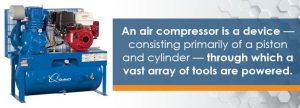
Key Takeaways: Pneumatic tools harness compressed air to deliver powerful, efficient performance across a wide array of tasks, from precise drilling to heavy-duty metal cutting. Understanding each tool’s specific CFM and PSI requirements is essential for matching it with the right air compressor to ensure optimal functionality and prevent underperformance. From delicate crafting with airbrushes […]
Read MoreHow to Read Air Compressor Gauges

Key Takeaways: Air compressors typically feature two gauges: a tank gauge to show pressure inside the tank, and a regulator gauge to display pressure delivered to tools. Both gauges measure pressure in pounds per square inch (PSI) and are read by observing a needle on a circular dial, similar to a vehicle’s speedometer. Maintaining the […]
Read MoreHow to Winterize Your Air Compressor

Key Takeaways: Winterizing your air compressor helps reduce energy costs, downtime, repairs, and damage from freezing temperatures. Regular maintenance, insulation checks, and weatherstripping inspections help protect your system from cold-weather issues. Monitor condensation and use heat trace tape, heaters, and properly adjusted louvers to prevent frozen drains, pipes, and components. As you manage demand for […]
Read MoreHow Paintball Guns Use Air Compressors

Key Takeaways: Compressed air gives paintball guns consistent pressure, helping improve accuracy, loading, and performance in different temperatures. Compared with CO2, compressed air provides steadier output, easier refilling, and less wear on paintball gun components. Paintball tanks typically require a specialized compressor rated between 3,000 and 5,000 PSI, rather than a standard hardware-store model. Compressed […]
Read MoreAll About Three-Phase Air Compressor Wiring

Key Takeaways: Three-phase power efficiently drives heavy-duty industrial compressors but is inherently incompatible with standard single-phase electrical systems found in most settings. Businesses with single-phase power can convert it for three-phase compressors using specialized systems like static converters, rotary phase converters, or variable frequency drives. Conversion methods like VFDs offer varying degrees of capacity, accuracy, […]
Read MoreHow Do Air Compressors Work?
Key Takeaways: Air compressors generate potential energy by forcing atmospheric air under pressure into a tank, which is then released as kinetic energy to power pneumatic tools. Air compression primarily uses either positive displacement, where air volume is reduced in a chamber, or dynamic displacement, which builds pressure rapidly with rotating blades. Common positive displacement […]
Read MoreThe Benefits of Switching from Mineral Oil Based Lubricants to Synthetic Lubricants in Air Compressors
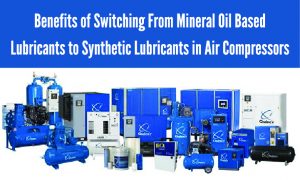
Key Takeaways: Synthetic lubricants can outlast mineral oils by six to 12 times in demanding air compressor applications, reducing oil change-outs, maintenance labor, and operating costs. Because synthetic oils resist oxidation, heat, contamination, and varnish buildup, they help protect internal components, improve energy efficiency, and extend compressor life. The right lubricant depends on the compressor […]
Read More